

Labor shortages, increasing SKU variation, rising production demands, higher retailer expectations, and tighter margins are pushing wet wipe manufacturers to automate more of their production lines.
But while selecting the right robot is important, it's rarely the factor that determines a project's success. The real differentiator is choosing a robotics systems integrator with the expertise to design, integrate, and support a solution that meets your production goals today and can scale with your business tomorrow.
In this guide, we'll walk through the most important criteria manufacturers should evaluate before selecting a robotics integration partner for wet wipe automation.
ARTICLE AT A GLANCE:
- Why Choosing the Right Integrator Is More Important Than Choosing the Robot
- Understand the Unique Challenges of Wet Wipe Automation
- Wet Wipe Automation Checklist: 10 Questions to Ask Before Choosing a Robotics Integrator
- Red Flags When Evaluating Wet Wipe Robotics Integrators
- How to Choose a Robotics Integrator Built for Wet Wipe Manufacturing
Why Choosing the Right Integrator Is More Important Than Choosing the Robot
Industrial robots from ABB, FANUC, and Stäubli are all proven platforms capable of delivering reliable performance in wet wipe manufacturing. The difference between a successful automation project and a disappointing one usually isn't the robot—it's how that robot is engineered into an existing or new production line.
A robotics integrator is responsible for designing the complete automation cell, including:
- Custom end-of-arm tooling for handling flexible wipe packages
- Vision systems for locating products, verifying lid placement, and applying adhesive
- PLC programming and robot controls
- Safety systems and risk assessments
- Integration with upstream and downstream equipment
- Factory acceptance testing, installation, and commissioning
Each of these elements affects production speed, uptime, product quality, and operator safety. If one component isn't engineered correctly, the entire system can suffer, regardless of which robot brand is used.
Because no two wet wipe production lines are exactly alike, experienced integrators design around your products, line layout, throughput requirements, staffing, and future expansion plans instead of relying on a standard, one-size-fits-all solution.
For a closer look at designing automation systems that can adapt as production needs change, read Wet Wipe Automation: Ensuring Scalable Robotic Solutions.
Understand the Unique Challenges of Wet Wipe Automation
Automating wet wipe production is more complex than many other packaging applications. Unlike rigid products that maintain a consistent shape, wet wipe packages, lids, and adhesives introduce variables that require precision engineering and specialized automation solutions.
Flexible Packages
Wet wipe pouches are lightweight and flexible, making them more difficult to handle than rigid containers or boxes. Package dimensions, fill levels, and material characteristics can all affect how products move through an automated system. Robotics must be able to pick, place, and position each pouch consistently without damaging the packaging or disrupting production.
Multiple Lid Styles & SKUs
Wet wipe manufacturers often produce multiple product lines with different lid sizes, hinge designs, and retailer-specific packaging requirements. An automation system must accommodate these variations while maintaining precise lid placement across every SKU.
Adhesive Precision
Applying adhesive isn't simply a matter of dispensing glue. Too little adhesive can lead to lid failures, while too much may affect product appearance or performance. Automated systems must deliver consistent adhesive patterns and repeatable lid placement to help maintain product quality and reduce waste.
High-Speed Production
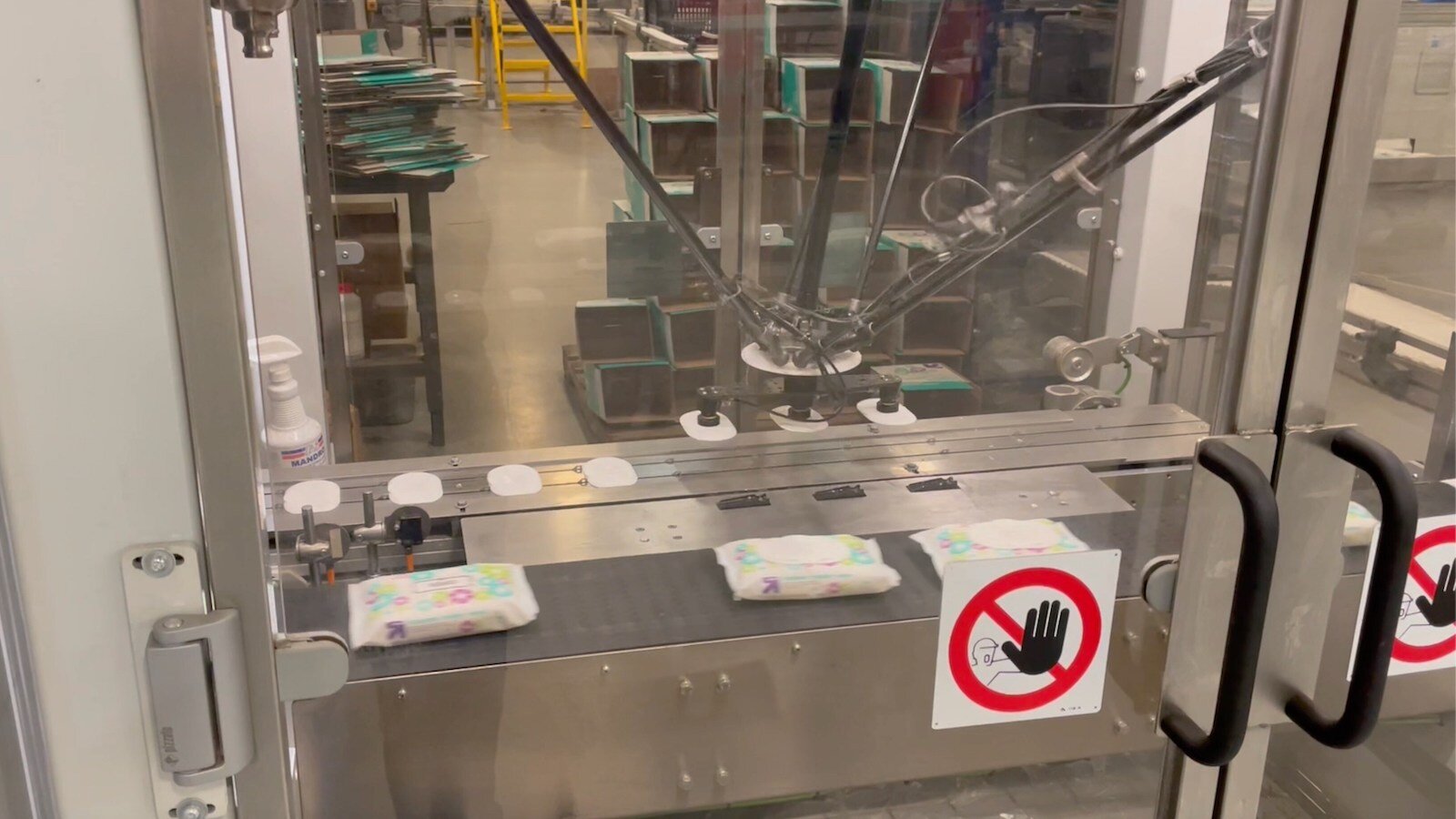
Modern wet wipe production requires automation that can keep pace with demanding throughput requirements. QComp's robotic wet wipe lidding solution can apply 150+ lids per minute, depending on the application and upstream/downstream operations, while maintaining precise adhesive application and lid placement.
Integrators with wet wipe manufacturing experience are more likely to anticipate the challenges involving flexible packaging, adhesive application, and SKU variation during the design phase, showing the importance of working with an experienced provider.
Case Study: High-Speed Wet-Wipe Lidding
A wet wipe manufacturer partnered with QComp to automate its lid application process. The robotic system operates at 150 pouches per minute and uses custom programming that enables rapid changeovers between SKUs and lid configurations. The result is a flexible automation solution designed to support high production rates while adapting to evolving product lines.
→ View the Full Wet-Wipe Robotic Automation Case Study
Wet Wipe Automation Checklist: 10 Questions to Ask Before Choosing a Wet Wipes Robotics Integrator
Not all robotics integrators have experience with the unique demands of wet wipe manufacturing. These questions can help you evaluate potential partners and identify solutions that align with your production goals.
1. Do They Have Experience Specifically in Wet Wipe Manufacturing?
Experience in general packaging automation doesn't always translate to wet wipe production. Flexible pouches, adhesive application, and lid placement require specialized engineering.
Ask about:
- Wet wipe automation projects
- Customer references
- Case studies
- Production rates achieved
- Installed systems similar to yours
2. Can Their System Handle Multiple SKUs?
Product portfolios evolve over time. An automation system should support current products while allowing for future packaging changes without requiring a complete redesign.
Look for support for:
- Multiple pouch sizes
- Different lid styles and dimensions
- Retailer-specific packaging
- New product introductions
3. How Fast Are Product Changeovers?
Frequent changeovers can reduce productivity if adjustments require extensive manual intervention.
Ask whether the system includes:
- Recipe-driven HMI changeovers
- Quick tooling swaps
- Automatic parameter adjustments
- Minimal operator involvement
4. Can They Integrate With Existing Equipment?
A robotic cell is only one part of the production line. The system should communicate seamlessly with upstream and downstream equipment to maintain product flow.
Discuss integration with:
- Conveyors
- Filling equipment
- Inspection systems
- Labeling equipment
- Case packing
- Palletizing
- Production software
Learn More About Common Integration Challenges
5. What Vision Technology Do They Use?
Vision systems allow robots to adapt to normal variations in product position and orientation, reducing rejects and improving consistency.
Ask whether the system includes:
- 3D vision technology
- Product tracking
- Lid orientation verification
- Adaptive positioning
6. How Do They Handle Safety?
Safety is the highest priority and should be incorporated into the system from the beginning.
Ask about:
- Risk assessments
- Machine guarding
- Applicable safety standards
- Operator access and maintenance procedures
- Whether the integrator follows A3-certified safety practices
7. Can the System Scale With Future Growth?
Production requirements rarely stay the same. Automation should support expansion without requiring you to start over.
Consider whether the design allows for:
- Additional robotic cells
- Increased throughput
- Automated bundling
- Case packing and palletizing
- Future line expansions
8. What Does Long-Term Support Look Like?
Support after installation can have a significant impact on system uptime and long-term performance.
Ask what is included:
- Spare parts availability
- Field service
- Remote support and monitoring
- Programming assistance
- Software updates and system upgrades
9. Can They Demonstrate Real ROI?
Automation investments should be supported by measurable business outcomes.
Request examples showing improvements in:
- Labor utilization
- Production uptime
- Product consistency
- Scrap reduction
- Employee redeployment
For an example of how robotic wet wipe lidding can deliver measurable operational improvements, read Robotic Automation ROI Analysis: Wet-Wipe Lidding Applications.
10. Will They Challenge Your Assumptions?
The best integrators do more than respond to specifications. They evaluate the entire production process and identify opportunities that may not have been considered.
During the evaluation process, look for recommendations related to:
- Production bottlenecks
- Facility layout improvements
- Safety enhancements
- Opportunities for future expansion
Strong automation projects often begin with an integrator asking questions you might not have thought to ask. That’s generally a good sign they’ve done this a time or two and know what they’re doing.
Wet Wipe Integrator Evaluation Checklist Summary
|
Evaluation Criteria |
Business Impact |
|
Wet wipe manufacturing experience |
Faster implementation and fewer application-specific issues |
|
Multi-SKU capability |
Supports new products without major system modifications |
|
Vision systems |
Improves lid placement accuracy and product consistency |
|
Integration expertise |
Reduces production disruptions and improves line performance |
|
Safety practices |
Helps protect employees and supports regulatory compliance |
|
ROI analysis |
Validates the business case before investing |
|
Service and support |
Maximizes uptime after installation |
|
Scalability |
Accommodates future production growth and automation expansion |
Red Flags When Evaluating Wet Wipe Robotics Integrators
Not every robotics integrator is equipped to handle the complexities of wet wipe manufacturing. Watch for these warning signs during the evaluation process:
- Providing a quote without first evaluating your facility or production line
- Recommending a one-size-fits-all solution instead of a custom-engineered system
- Limited or no experience with wet wipe manufacturing or similar applications
- Inability to provide customer references or relevant case studies
- Lengthy, manual product changeovers that reduce production uptime
- Systems that can't accommodate future SKUs or production expansion
- Little or no post-installation service, training, or technical support
One or two of these red flags may warrant additional questions. Several together should prompt you to evaluate other integration partners.
How to Choose a Robotics Integrator Built for Wet Wipe Manufacturing
Choosing a wet wipe robotics integrator is about more than selecting a company to install equipment. The right partner understands your production requirements, designs solutions that can adapt as your business grows, and provides the expertise and support needed to maximize your investment for years to come.
For more than 30 years, QComp has helped manufacturers automate complex production challenges, developing automation solutions tailored to each customer's operation. As an A3 Certified robotics integrator and partner of ABB, FANUC, and Stäubli, QComp combines proven technology with engineering expertise and long-term service and support.
Learn more about QComp's Wet Wipe Lid Application Solutions, or contact the QComp team to discuss your wet wipe automation project and explore solutions designed around your
Frequently Asked Questions About Wet Wipe Automation
What does a robotics integrator do?
A robotics integrator designs, builds, installs, and services complete automation systems. This includes engineering the robotic cell, integrating vision systems and controls, developing custom end-of-arm tooling, implementing safety measures, and ensuring the system works seamlessly with existing production equipment.
How long does a wet wipe automation project take?
Project timelines vary depending on the complexity of the application, equipment requirements, and production goals. Factors such as custom tooling, system integration, testing, and installation all influence the overall schedule. An experienced integrator can provide a more accurate timeline after evaluating your application.
Can robotics handle multiple wet wipe package sizes?
Yes. Modern robotic systems can be designed to accommodate multiple pouch sizes, lid styles, and product configurations. Recipe-driven controls and flexible tooling make it easier to switch between SKUs while minimizing downtime.
What should I ask during an automation consultation?
Ask about the integrator's experience with wet wipe manufacturing, similar projects they've completed, expected production rates, changeover capabilities, system scalability, safety practices, and the level of service and support provided after installation.
Can robotics be added to an existing production line?
In many cases, yes. Robotic systems can often be integrated with existing conveyors and upstream or downstream equipment, allowing manufacturers to automate specific processes without replacing an entire production line.
What production speeds can robotic wet wipe systems achieve?
Production speeds depend on the application and system design. QComp's robotic wet wipe lid application solution can apply 150+ lids per minute, depending on the application and upstream/downstream operations.
What is robotic lidding?
Robotic lidding is an automated process that uses industrial robots to place lids, covers, or tops onto containers, trays, cases, or other products. The robot picks and positions each lid with consistent accuracy, helping manufacturers increase throughput, reduce repetitive manual handling, and improve product consistency. Robotic lidding systems can also be integrated with other processes such as product handling, case packing, sealing, labeling, and palletizing for a more complete end-of-line automation solution.
Share this
Automated Lidding for Nonwoven Wet Wipes: Robotic Solutions
Learn how advanced robotic automation solves wet wipe lidding challenges, enhancing speed, precision, and scalability to meet rising market demands.
Improving Glass Industry Safety: How Automation Helps Prevent Injuries
How to improve safety in the glass manufacturing industry using robotic automation. Explore how a leading robotics integrator is solving the toughest challenges.
Overcoming the Challenges of Robotics Integration
Explore considerations when integrating robotics into an existing production line and potential challenges including space constraints, utilities, safety, and more.