

For glass manufacturers, deciding whether to automate a production line starts with evaluating the right data. While some companies initially focus on breakage, damaged products are often only a small piece of the equation. Across glass fabrication, window and door manufacturing, and applications like appliances and solar products, manufacturers are increasingly evaluating robotics to improve safety, consistency, and operational efficiency.
In many facilities, the bigger operational challenges involve:
- Worker safety
- Labor shortages
- Inconsistent throughput
- Ergonomic strain
- Inefficient production flow
Identifying where those issues exist can help manufacturers determine whether robotics will deliver measurable value.
Before investing in automation, it is important to understand which metrics actually matter. This article explores the operational data glass manufacturers should evaluate when assessing robotics for a glass line.
What Data Should Glass Manufacturers Evaluate Before Investing in Robotics?
-
Safety risks (manual lifting, repetitive motion, injuries)
-
Throughput constraints (bottlenecks, idle time, tempering furnace efficiency)
-
Labor challenges (turnover, staffing shortages, overtime)
-
Process variation (glass size, thickness, changeovers)
-
Operational reliability (sensors, controls, repeatability)
Why Breakage Data Is Not the First Metric to Evaluate
When evaluating robotics for a glass manufacturing line, breakage rates often receive immediate attention. While scrap reduction can contribute to ROI, most glass facilities already account for some level of breakage as part of normal operations.
In practice, robotics decisions are more commonly driven by operational risk and process limitations. If employees are manually lifting glass, working near dangerous transfer points, or struggling to maintain production demands, those issues often create a stronger business case for automation than damaged product alone. Robotics can reduce physical exposure to hazardous handling areas while creating more consistent movement through the line.
The Hidden Cost of Focusing on the Wrong Metric
Focusing too heavily on scrap data can obscure larger performance issues affecting profitability. Lost productivity from manual handling, injury-related downtime, staffing instability, and operational bottlenecks can create ongoing costs that are harder to measure, but often more expensive over time.
In many cases, the greatest value of robotics comes from improving process reliability and reducing operational strain rather than simply lowering breakage.
If your automation strategy starts and ends with scrap reduction, you’re likely missing higher-impact opportunities.
Why Safety Data Often Reveals the Strongest ROI for Robotics
Glass handling environments involve sharp edges, repetitive lifting, awkward movements, and high-speed production — all of which increase injury risk. Before evaluating automation based on breakage or throughput, manufacturers should first identify where employees face the greatest physical strain and safety risks.
Which Parts of the Glass Line Create the Greatest Risk?
The highest-risk areas are often where employees repeatedly lift, move, or position glass by hand. This commonly includes rack loading and unloading, tempering furnace loading, end-of-line packing/crating, and other high-speed handling zones where workers must move quickly to keep pace with production.
Interestingly, heavier glass is not always the biggest concern. In many facilities, smaller glass pieces weighing 60–70 pounds create greater ergonomic risk because faster line speeds increase repetitive lifting and twisting throughout a shift.
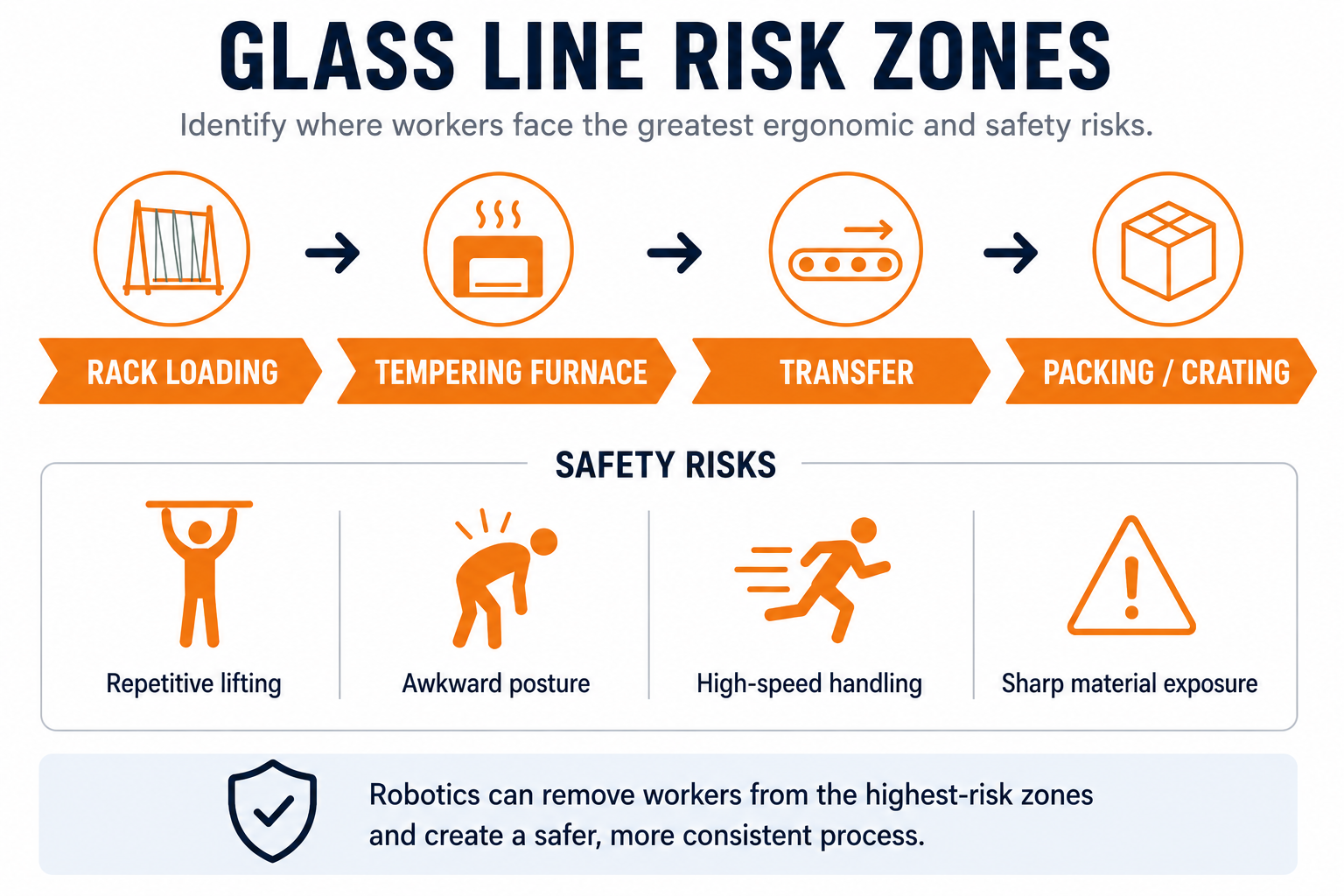
Image: Common ergonomic and safety risk zones across a glass production line, from rack loading to end-of-line packing
Measure Repetitive Motion and Injury Risk
Manufacturers should review operational and safety data to identify where automation could reduce risk. Useful metrics include:
- OSHA incident logs and near misses
- Workers’ compensation claims
- Repetitive strain injuries
- Manual lifting frequency
- Average glass weight handled
OSHA recommends evaluating workplace risk factors such as repetitive motion, forceful exertion, awkward postures, and lifting tasks when identifying ergonomic hazards in manufacturing environments.1
How Robotics Creates Physical Separation Between People and Glass
One of robotics’ greatest advantages is removing employees from dangerous handling zones. Instead of repeated physical exertion, workers can supervise automated movement between harp racks, conveyors, furnaces, and packaging areas, reducing exposure to cuts, breakage events, and strain.
Mini Case Study: Improved Job Safety & Satisfaction
A Texas glass line employee developed a hernia after years of repetitive lifting and twisting. Rather than losing his role, automation helped him transition into operating the robotic system that now racks and packages glass, shifting his job from physical strain to process oversight. He also appreciates not having to wear heavy and uncomfortable Kevlar PPE all day.
RELATED: Improving Glass Industry Safety: How Automation Helps Prevent Injuries
How Can Glass Manufacturers Evaluate Throughput Before Investing in Robotics?
Can a robot help your line move faster? Not always. And that distinction matters.
While some glass manufacturers see meaningful throughput gains from robotics, others invest primarily to improve safety or address labor shortages. According to our evaluations of glass manufacturing data, roughly half of facilities experience noticeable speed improvements.
Where robots improve output, the advantage often comes from consistency. Unlike manual processes, robotic systems maintain predictable cycle times and operate continuously without breaks. Reliable operation provides predictable data and consistent results over time.
What Throughput Data Should Glass Manufacturers Measure?
Rather than focusing only on average production speed, manufacturers should identify where output slows down.
Key production data to evaluate includes:
- Tons processed per hour
- Conveyor idle time
- Line stoppages
- Manual transfer delays
- Slowdowns caused by operator fatigue
A robotic system may create the greatest value at a single bottleneck rather than across the entire line.
Why Energy Efficiency Matters More Than Many Manufacturers Realize
In tempering applications, profitability often depends on how efficiently glass moves through the tempering furnace. Robots can precisely “gap” sheets closer together without touching, maximizing conveyor space and thermal efficiency. Even small spacing inconsistencies can reduce furnace utilization, increase energy costs, and limit throughput.
What Labor Data Should Glass Manufacturers Evaluate Before Automation?
For many glass manufacturers, labor challenges, not speed, are what ultimately justify automation. Robotics investments are often triggered by a simple operational reality: critical positions are difficult to staff consistently.
Labor shortages remain a persistent challenge. According to Glass Magazine and the National Glass Association, labor is consistently identified as the industry’s top operational pain point, with more than half of leading glass companies reporting recruitment challenges. Meanwhile, the broader manufacturing sector continues to report hundreds of thousands of open jobs in 2026.2
How Difficult Is It to Staff Your Glass Line?
Before evaluating robotics, manufacturers should assess where labor instability creates operational strain.
Key workforce metrics include:
- Open positions
- Time-to-hire
- Turnover rates
- Injury-related exits
- Position vacancy duration
- Training and onboarding costs
- Overtime dependency
- Temporary labor usage
If a position consistently slows production because of absenteeism, turnover, or hiring challenges, it may already be an automation candidate.
If one position is constantly difficult to fill, it may be a prime automation candidate.
How Do You Know If a Glass Process Is a Good Candidate for Robotics?
Not every glass process is suited for automation. Before investing in robotics, manufacturers should evaluate how much variation exists within production. Glass size ranges, thickness variation, product changeovers, and new product introductions all influence system complexity.
A line producing consistent products may be easier to automate than one handling highly variable dimensions or frequent production changes. Robotics are powerful, but they are not infinitely flexible. Greater process variation often requires more programming, tooling, and validation.
Sensors and Vision Systems Improve Reliability
Modern robotic systems rely on sensors and monitoring technology to improve handling accuracy and reduce disruption. Depending on the application, systems may verify whether glass is successfully picked, sense positioning on racks or conveyors, measure spacing between sheets, and trigger alarms if placement falls outside acceptable parameters.
In tempering and transfer applications, precise positioning matters. Even small spacing inconsistencies can affect downstream efficiency, making reliable sensing essential to maintaining consistent throughput.
Why Automation Changes Are Not Always “Quick Fixes”
One common misconception about automation is that robot changes are simple because “it will just require a quick adjustment to the software program.” In reality, modifying a robotic process requires much more, including:
- Motion path testing
- Collision avoidance checks
- Safety validation
- Verification that guarding zones remain compliant
Even seemingly small adjustments can expand project scope and require extensive testing before implementation. Safety validation and testing take time, especially in glass handling applications.
RELATED: Why A3 Safety Certification Matters in Robotics
A Practical Checklist for Evaluating Robotics on a Glass Line
The strongest automation opportunities often emerge where safety, labor, and throughput challenges overlap. Use the questions below to identify high-impact opportunities on your glass line.
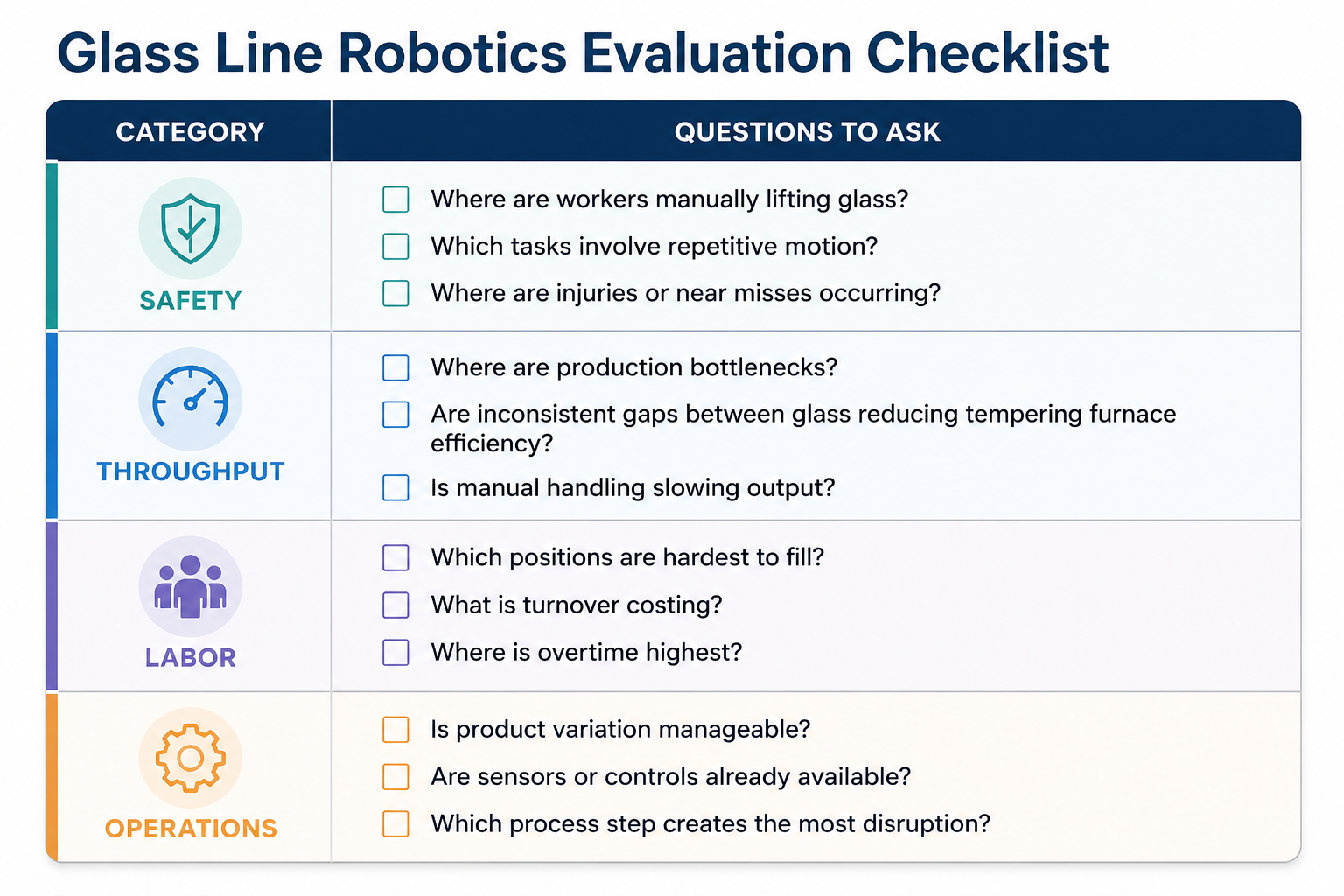
In many facilities, the best opportunity is a single high-risk or high-friction process rather than an entire production line.
The goal of glass line automation is not simply to determine whether robotics are possible. It is to determine where it will create the greatest operational impact.
The Best Robotics Decisions Start With the Right Data, and the Right Partner
Rather than approaching automation as an all-or-nothing decision, manufacturers should begin by evaluating the data behind their biggest production challenges. The strongest robotics investments are often highly targeted solutions designed around a specific bottleneck, risk area, or labor constraint.
The key is understanding which operational constraints are creating the greatest impact on safety, productivity, and profitability.
Not sure where robotics could create the biggest impact on your glass line? Contact QComp to review your production environment and identify where automation could improve performance, consistency, and worker safety.

Sources:
-
1 Occupational Safety and Health Administration (OSHA), Ergonomics Overview.
-
2 Glass Magazine, Struggling to Keep Production or Field Personnel? December 8, 2025.
Frequently Asked Questions About Glass Manufacturing Robotics
What data should glass manufacturers evaluate before investing in robotics?
Glass manufacturers should evaluate safety risks, throughput constraints, labor challenges, process variability, and operational bottlenecks before investing in robotics. Key metrics include injury reports, repetitive motion exposure, conveyor idle time, turnover rates, furnace efficiency, and manual handling requirements. The strongest automation opportunities are often identified through operational data rather than breakage rates alone.
Is reducing glass breakage the main reason manufacturers invest in robotics?
Not always. While reducing breakage can improve ROI, many manufacturers invest in robotics to address worker safety, labor shortages, repetitive lifting, and inconsistent throughput. In many facilities, the cost of injuries, staffing instability, or production bottlenecks outweigh the cost of damaged products.
Which parts of a glass line are best suited for automation?
High-risk and repetitive tasks are often the best automation candidates. This commonly includes rack loading and unloading, tempering furnace loading, glass transfer points, and end-of-line packing or crating, where manual handling creates ergonomic strain or slows production.
Can robotics improve throughput in glass manufacturing?
Yes. Some facilities experience meaningful throughput gains through consistent cycle times, reduced manual delays, and improved furnace loading efficiency. However, many manufacturers automate primarily to improve safety or labor stability rather than increase speed.
How do manufacturers know if a glass process is a good candidate for robotics?
A glass process may be a strong automation candidate if it involves repetitive manual lifting, difficult-to-fill positions, recurring injuries, production bottlenecks, or consistent product handling requirements. A process review can help determine technical feasibility and expected ROI.
How can robotics improve worker safety in glass manufacturing?
Automation improves safety by reducing direct human interaction with heavy or sharp glass materials. Automated systems can handle repetitive lifting, furnace loading, and transfer tasks, allowing employees to move from physically demanding work into supervisory or monitoring roles that reduce injury exposure.
Share this
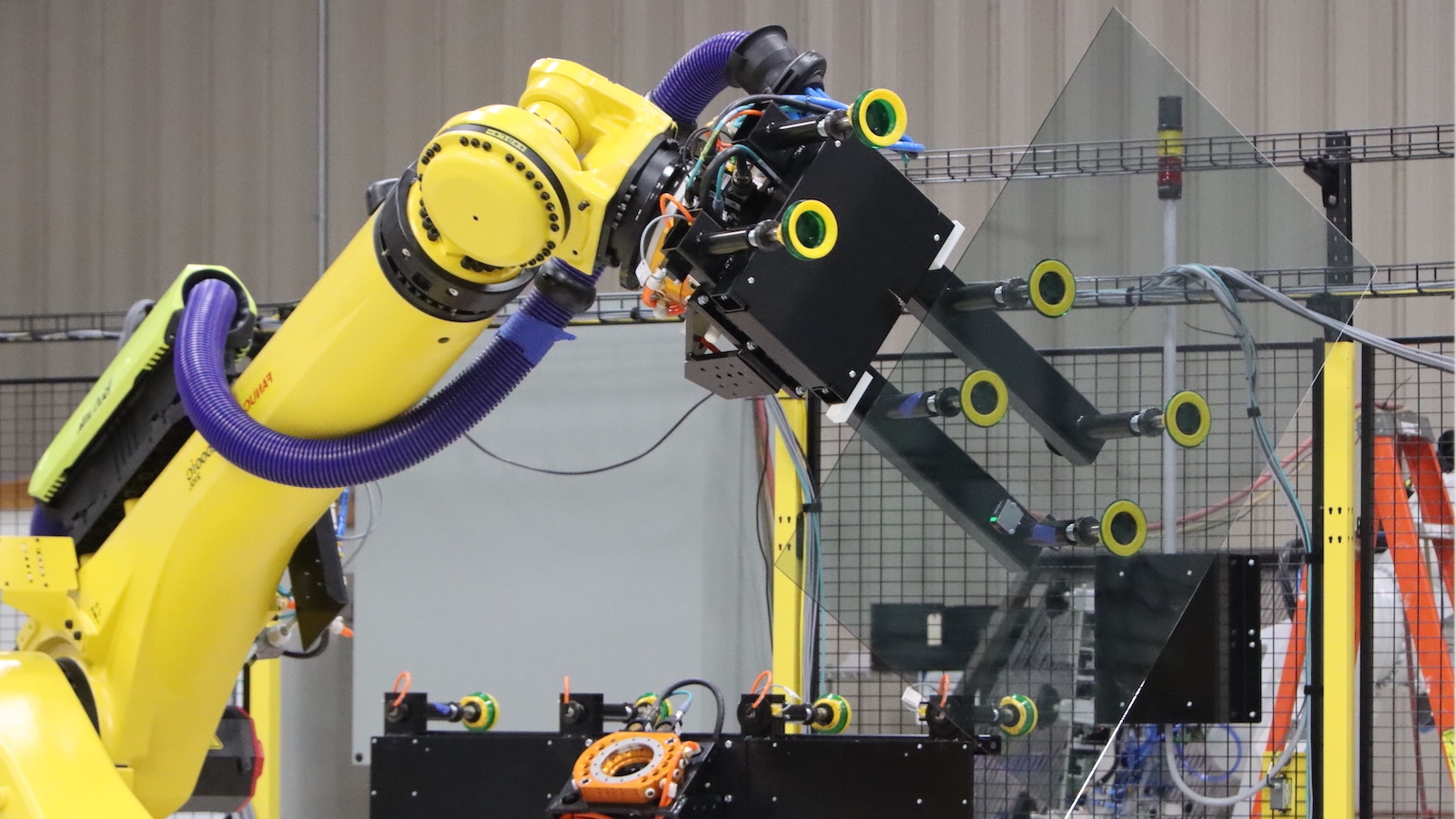
Improving Glass Industry Safety: How Automation Helps Prevent Injuries
How to improve safety in the glass manufacturing industry using robotic automation. Explore how a leading robotics integrator is solving the toughest challenges.
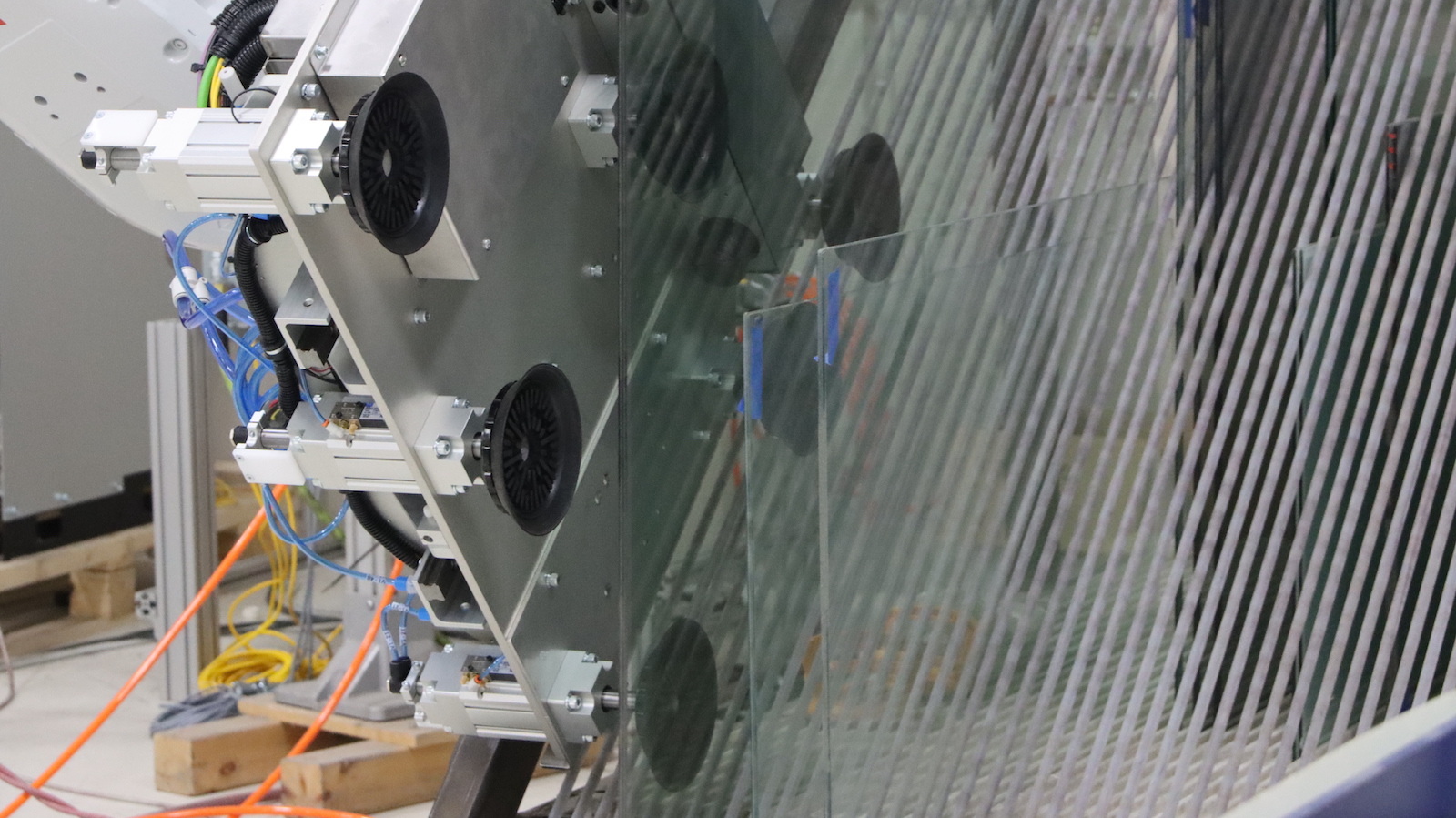
Automation Challenge: Glass Industry Harp Rack Loading
Learn how QComp’s innovative harp rack unloading automation improves glass industry safety, reduces risks, and boosts precision and productivity.
When to Retrofit vs. Replace Automation Systems: An Engineer’s Perspective
Evaluate when to retrofit vs. replace automation systems. Learn how usage, obsolescence, and goals impact the right robotics investment decision.