Glass Manufacturing Has Changed. So Has Automation.
Producing high-quality glass requires precision. Today, glass manufacturers face added challenges: achieving that precision while meeting increasing production demands, labor shortages, safety requirements, and rising quality expectations.
It used to be that robotics could only pick-and-place glass panels. Modern automation now supports nearly every phase of the manufacturing process—from the moment glass leaves the production line until it's packaged and ready for shipment.
In this article, we’ll walk you through each stage of a typical glass production line and explore where robotics deliver the greatest value.
View Glass Automation Solutions
Stage 1: Glass Leaves the Production Line
The first handling challenge begins as glass exits production and moves into the next stage of the manufacturing process. Float glass, insulating glass units, tempered glass, or laminated glass needs to move to the next phase without disrupting production flow.
At this point, glass is:
- Large, heavy, and difficult to maneuver
- Fragile and susceptible to edge damage, scratching, cracking, and breakage
- Moving at high production speeds
- Often too hazardous for repetitive manual handling
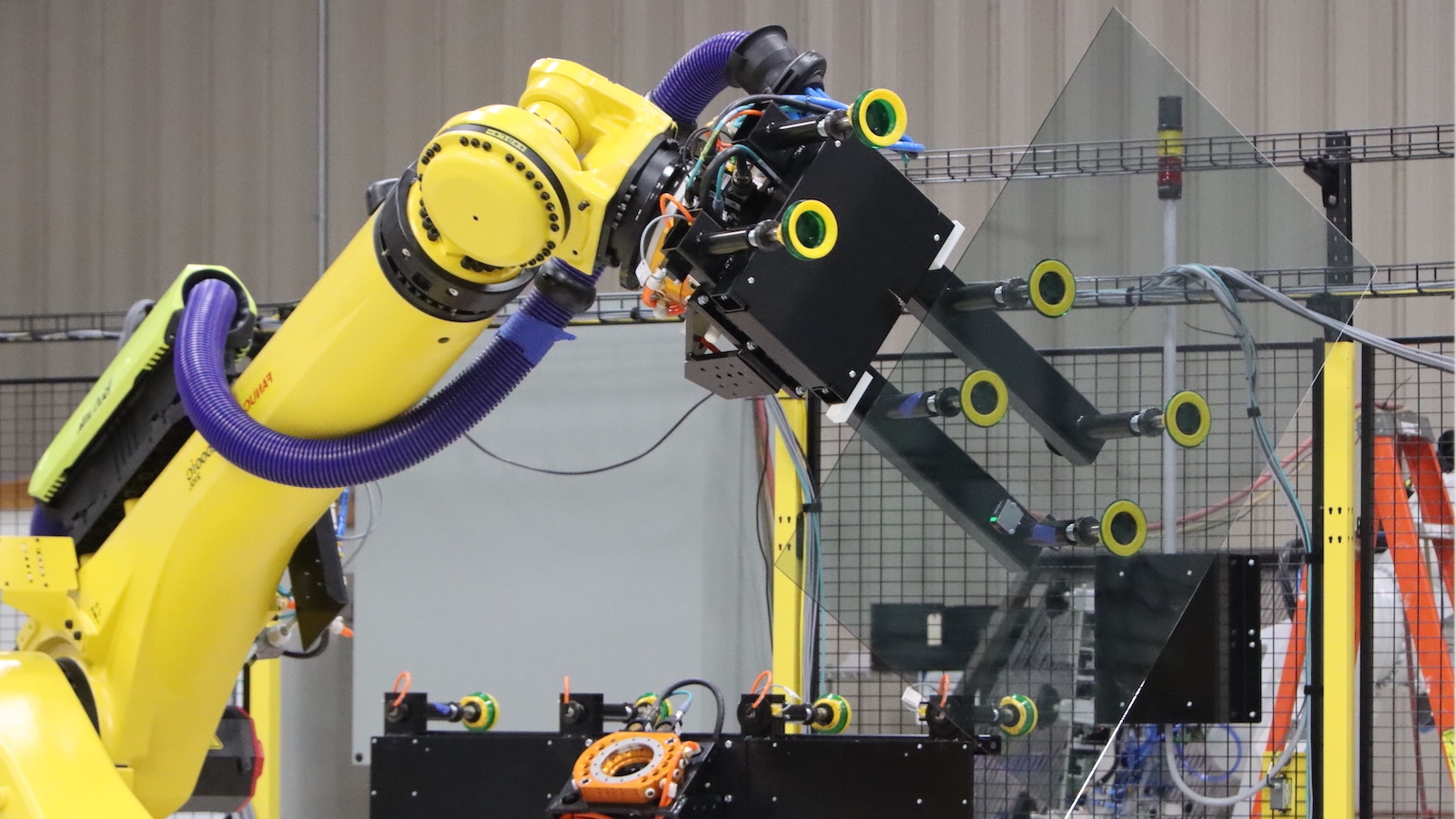
Robotic glass handling systems can take over these transfers, picking large pieces of glass and moving them between conveyors, racks, inspection stations, and downstream processing equipment. Depending on the application, robots can be engineered with end-of-arm tooling designed to securely handle large glass surfaces while controlling orientation and placement throughout the transfer.
Accurate positioning is especially important when the next operation depends on consistent glass location and alignment. A properly integrated robotic system can coordinate with conveyors and other production equipment so that each piece enters the next process in a repeatable position without becoming a bottleneck in the line.
Benefits of Robotic Glass Handling at Line Exit
- Reduced glass damage: Controlled movement and repeatable handling can reduce the impacts, misalignment, and handling errors that lead to damaged glass
- Improved operator safety: Automation reduces the need for employees to repeatedly lift, guide, or reposition large and potentially hazardous glass products
- Consistent handling across product sizes: Robotic systems can be configured to accommodate the range of glass dimensions and formats produced within a facility
- Reliable production flow: Automated transfers help glass continue through production at a consistent pace while keeping downstream processes supplied
RELATED ARTICLE: Optimizing Glass Line Load and Unload
Stage 2: Inspection and Quality Control
Glass inspection depends on consistency. Each piece must be presented to inspection equipment in the correct position and orientation so quality systems can accurately evaluate the product without slowing the production line.
Robotics can integrate with machine vision and automated inspection systems to support quality checks for defects such as scratches, chips, surface imperfections, dimensional issues, and other conditions that may make a piece unacceptable.
During inspection, robotic systems can:
- Position and orient glass for inspection equipment
- Coordinate glass movement with cameras, sensors, and vision systems
- Automatically route accepted glass to the next process
- Remove rejected glass from the production flow for rework or disposal
This integration allows inspection results to trigger the next action automatically. When a vision system identifies a defect, for example, the robotic system can route that piece appropriately while acceptable glass continues downstream.
Benefits of Robotics in Glass Quality Control
- Consistent inspection conditions: Repeatable positioning helps inspection equipment evaluate each piece under controlled conditions
- Automated reject handling: Defective glass can be removed from production without requiring operators to intervene in the normal process flow
- Faster response to quality issues: Inspection data can immediately determine where a piece of glass goes next
- Integrated quality control: Robotics, vision systems, inspection equipment, and downstream processes can operate as one coordinated system
Stage 3: Material Handling Between Processes
Glass rarely moves through manufacturing in one continuous, uninterrupted line. Depending on the finished product, it may travel between:
- Washing
- Edge processing
- Tempering
- Laminating
- Assembly
- Storage
- Packaging equipment
Transfers between these processes can become bottlenecks, particularly when equipment operates at different cycle times or requires glass to enter in a specific orientation.
Robotic material handling systems can automate these transitions and coordinate the movement of glass throughout the facility. A system may transfer glass directly from one machine to another, rotate or reorient it for the next operation, or temporarily stage material when downstream equipment is not ready to receive it.
This type of automation can also connect equipment that was not originally designed to operate as a single integrated line. Robots, conveyors, controls, sensors, and production equipment can be engineered to work together based on the requirements of each process.
Benefits of Robotic Material Handling Between Glass Processes
- Fewer production bottlenecks: Coordinated transfers help keep material moving between equipment with different cycle times
- Reduced manual intervention: Operators spend less time moving, rotating, and staging glass between processes
- Greater process flexibility: Robots can accommodate changes in glass size, orientation, destination, and production sequence
- Better equipment integration: Custom automation can connect individual processes into a more coordinated manufacturing system
Stage 4: Sorting and Product Management
Glass manufacturers often run a wide variety of products through the same facility. Glass size, thickness, coating, processing requirements, and customer specifications can vary from one order to the next, creating a complex sorting and routing challenge.
Automated systems can use product and production data to determine where each piece needs to go. Depending on the operation, sorting decisions may be based on:
- Glass dimensions, thickness, or type
- Coatings or other product characteristics
- Customer orders and production schedules
- Results from upstream quality inspections
- Downstream processing or packaging requirements
Robotics can then execute those decisions, directing each piece to the appropriate rack, process, staging area, or packaging line. This allows manufacturers to manage mixed production while maintaining an organized product flow.
RELATED ARTICLE: Automation Challenge: Glass Industry Harp Rack Loading
Benefits of Automated Glass Sorting and Product Management
- Accurate product routing: Glass is directed to the correct destination based on predefined production requirements
- Efficient mixed-product production: Multiple glass configurations and orders can move through the facility without relying on manual sorting
- Better order management: Automation can help keep individual products aligned with customer and production requirements
- Reduced sorting errors: Automated identification and routing reduce opportunities for products to be sent to the wrong process or destination
Stage 5: Packaging and Palletizing
Packaging and palletizing bring finished glass one step closer to shipment, but these tasks can involve repetitive handling of large, heavy, and fragile products. Employees may also be working near sharp edges, moving equipment, and heavy loads, making safety a particularly important consideration when automating this stage.
Robotic packaging and palletizing systems can be designed to:
- Stack glass in consistent configurations
- Handle finished products without damaging surfaces or edges
- Build repeatable pallet or rack patterns
- Accommodate multiple glass sizes and product configurations
- Prepare finished products for storage or shipment
Automating these repetitive tasks can reduce direct operator interaction with glass while producing consistent loads for downstream handling and transportation. Robotic systems can also maintain repeatable stacking and placement over long production runs.
Benefits of Robotic Glass Packaging and Palletizing
- Safer working conditions: Automation reduces repetitive employee interaction with heavy, fragile glass during packaging and palletizing
- Consistent load building: Repeatable placement creates organized pallets and racks for storage and transportation
- Reduced finished-product damage: Controlled handling helps protect glass surfaces and edges during the final stages of production
- Flexible packaging: Robotic systems can be engineered to accommodate different product dimensions, load patterns, and packaging requirements
Safety Depends on More Than the Robot
A complete robotic cell, including guarding, sensors, controls, access points, and safety procedures, needs to be designed around the application and the people working nearby. Partnering with an A3 Certified Robot Integrator, such as QComp, helps manufacturers ensure robotic systems are designed and integrated according to established industry safety standards and best practices.
Get the Guide: Improve Safety and Efficiency in Glass Manufacturing with Robotics
Stage 6: Preparing for Shipment
Before finished glass leaves the facility, manufacturers need to confirm that the right products are organized for the right shipment. For operations managing multiple glass types, sizes, and customer orders, automation can help maintain that accuracy through the final handoff.
Robotic systems can work with identification, SKU tracking, and plant control systems to support:
- Final handling and load preparation
- Organization of finished products by order or destination
- Product and order verification
- Traceability throughout the final stage of production
- Production and shipment reporting
As products move into shipping, data collected throughout the automated process can provide a record of what was produced, inspected, sorted, and prepared for each order. This gives manufacturers greater visibility into finished goods and can make it easier to investigate issues if questions arise after a shipment leaves the facility.
Benefits of Automation in Glass Shipping Operations
- Improved shipment accuracy: Automated tracking and verification help ensure finished products are assigned to the correct customer order
- Greater traceability: Production and product data can follow glass through the final stages of manufacturing
- Better production visibility: Integrated systems can provide useful information about completed orders, finished goods, and production activity
- More predictable shipping workflows: Repeatable processes help keep finished glass organized as it moves from production to shipment
The Biggest Opportunity: Connecting the Entire Process
One of the biggest misconceptions about industrial robotics is that manufacturers need to automate individual tasks. In reality, the greatest gains come from integrating multiple processes into one production flow, seamlessly connecting each stage.
- What happens at inspection can determine where a piece of glass goes next
- Production schedules influence sorting
- Downstream equipment dictates material flow
- Order information ultimately determines how finished products are packaged and prepared for shipment
An integrated automation system connects all these decisions and movements across the glass manufacturing process. It can also integrate with existing equipment. Robots, conveyors, vision systems, inspection equipment, sensors, safety systems, and production controls can share information from one station to the other and respond to conditions elsewhere on the line.
RELATED ARTICLE: What Data Should Glass Manufacturers Evaluate Before Investing in Robotics?
Connecting automation across the facility can help glass manufacturers:
- Reduce manual touchpoints between processes
- Maintain a consistent flow of glass through production
- Respond automatically to changing production conditions
- Improve visibility into product location and production status
- Coordinate equipment with different cycle times and requirements
- Increase production capacity without adding manual handling at every stage
For glass manufacturers evaluating robotics, this broader view of the production process can uncover opportunities that extend well beyond an individual robotic cell. A well-integrated automation strategy creates a connected system that can adapt as product requirements, production volumes, and manufacturing needs evolve.
Glass Robot Videos: See Glass Handling Robotics In Action
Where Does Automation Fit in Your Glass Manufacturing Process?
Every glass manufacturing operation has its own combination of products, processes, equipment, production requirements, and physical constraints. Glass dimensions and coatings, line speeds, plant layout, existing machinery, and customer requirements all influence where robotics can provide the most value.
Finding those opportunities requires looking at how the entire operation works. QComp designs custom robotic automation around the realities of the production environment, whether the need is a single robotic cell or automation that connects multiple stages of glass manufacturing.
The right solution starts with understanding where production is constrained today and what the facility needs to accomplish next. If you're evaluating automation for your facility, our team can help identify where robotics will deliver the greatest return on investment.
View our glass automation solutions and talk to a QComp automation expert today about your glass manufacturing challenges and goals.
Frequently Asked Questions About Glass Handling Robotics
What types of glass can robotic systems handle?
Robotic systems can be engineered to handle many types of glass products, including float glass, insulating glass units, tempered glass, laminated glass, and coated glass. The robot, end-of-arm tooling, controls, and handling method are selected based on factors such as glass dimensions, weight, surface characteristics, and the requirements of the manufacturing process.
Can robots handle large or heavy glass panels?
Yes. Industrial robots can be integrated with specialized end-of-arm tooling to handle large, heavy glass lite and panels. The complete system must be engineered around the size and weight of the glass, required reach, movement, orientation, and conditions within the production environment.
What end-of-arm tooling is used for robotic glass handling?
Vacuum-based end-of-arm tooling is commonly used for robotic glass handling because it allows a robot to securely grip large glass surfaces without mechanical clamping on the edges. Tooling can be customized based on glass size, weight, surface characteristics, orientation, and the movements required by the application.
Can glass handling robots accommodate multiple product sizes?
Yes. Robotic glass handling systems can be designed for facilities that manufacture multiple product sizes and configurations. Depending on the application, the system can adjust handling parameters, tooling, positioning, and routing based on the product entering the cell.
Can robotics be integrated with existing glass manufacturing equipment?
Yes. A robotics integrator can design automation to work with existing conveyors, washers, inspection equipment, processing machinery, packaging systems, and other production equipment. Integration requirements depend on the equipment already in place, available controls and communication, plant layout, and the goals of the automation project.
How do you determine where to automate a glass manufacturing process?
A good starting point is to identify processes with frequent manual handling, safety concerns, production bottlenecks, inconsistent cycle times, difficult product movements, or capacity constraints. An experienced robotics integrator can evaluate these areas in the context of the entire production process and determine where automation is likely to provide the greatest value.
What should glass manufacturers look for in a robotics integrator?
Look for an integrator with experience designing custom automation, working with complex material-handling applications, integrating robots with existing production equipment, and engineering systems around industrial safety requirements. A3 Certified Robot Integrator status is also an important qualification when evaluating a partner for a robotic automation project.