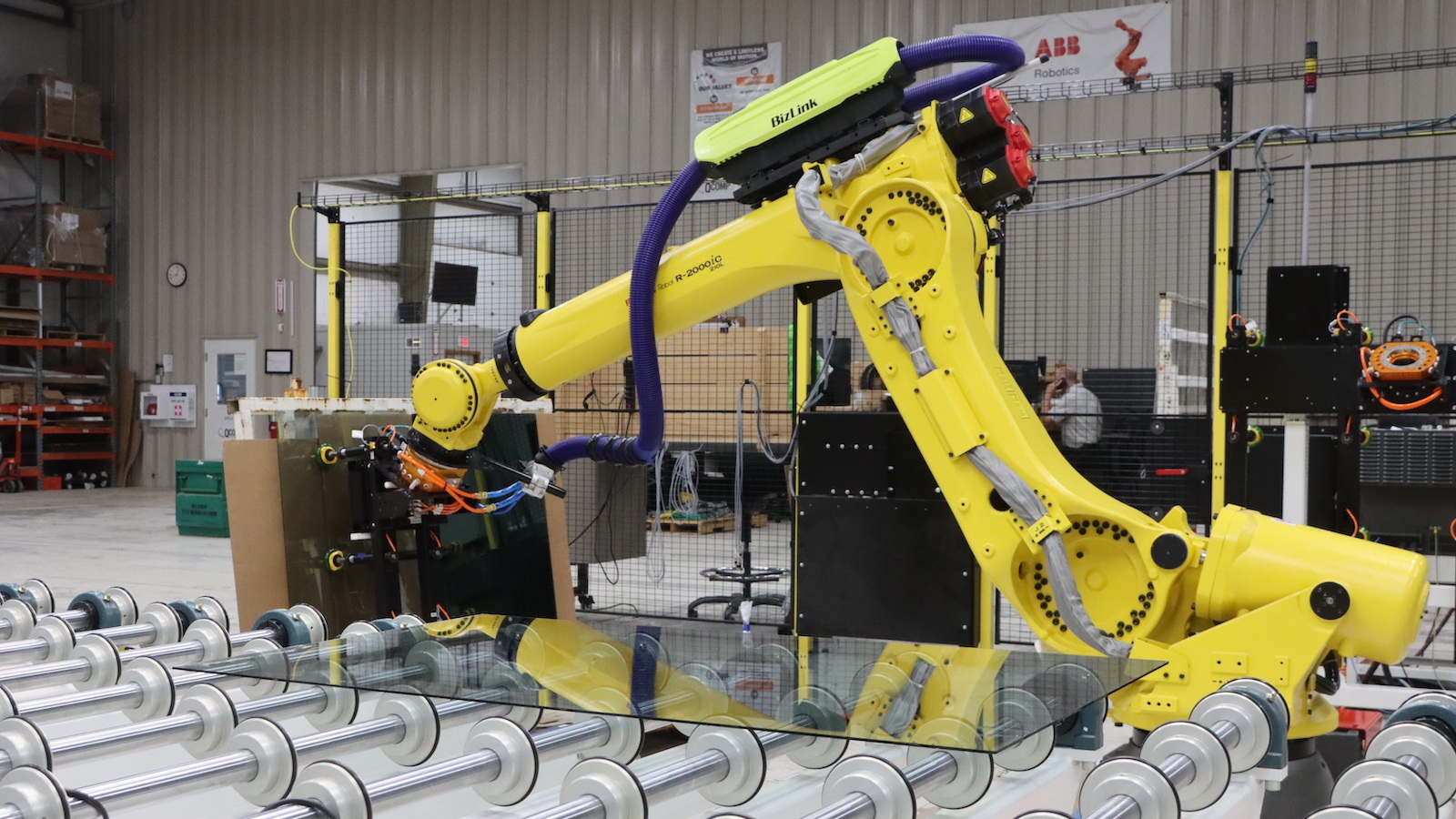
Robotic glass handling uses industrial robots, custom vacuum tooling, and controlled motion to move flat glass lites between lines and racks without damage. For other applications, robotic handling seems straightforward. A robot typically picks a product or box, places it on a pallet, and repeats the process.
Glass is different.
Its size, fragility, weight, and surface characteristics create handling challenges that standard robotic systems simply weren't designed to solve. And instead of pallets, glass panels typically need to be picked and placed onto harp racks or similar racks for transportation, requiring added precision.
What works for packaged goods can quickly lead to issues in the glass industry. In this article, we outline the major challenges and how successful glass manufacturers rely on robotic handling systems engineered specifically for glass.
Challenge #1: Preventing Damage Without Sacrificing Speed
Robots without proper programming can have rapid acceleration, abrupt stops, or poorly planned rotations, causing glass to shift, vibrate, or make contact with surrounding equipment. These conditions often lead to edge chips, surface scratches, scuffs, or damage to coatings that may not be discovered until later in production.
To protect glass, a custom robotic glass handling system uses motion profiles engineered around the size, weight, orientation, and handling requirements, allowing it to:
- Accelerate and decelerate smoothly
- Approach racks at the right speed and angle
- Follow controlled paths during transfers
- Precisely align glass for pickup or placement into harp racks
- Provide consistent spacing between lites
- Account for tin-side and air-side orientation based on glass coating and handling requirements
- Protect edges, coatings, and finished surfaces
Maintaining production throughput and speed while protecting glass requires precise control over every stage of the robot’s movement.
View Our Glass Automation Solutions
Challenge #2: Improving Safety & Ergonomics for Glass Handling Operators
Damaged glass can also lead to injuries, which is one of the biggest reasons glass manufacturers pursue glass handling automation. Flat glass manufacturing has a higher-than-average rate of workplace injuries and illnesses—nearly twice the private-industry average1—but robotic glass handling can help mitigate these risks by:
- Reducing exposure to sharp and broken glass
- Minimizing repetitive lifting and ergonomic strain
- Keeping workers away from hazardous handling areas
- Reassigning employees to safer, higher-value tasks
Automation can also help address persistent labor shortages. By reducing reliance on manual labor for physically demanding glass handling, manufacturers can maintain production with fewer operators while creating safer, more sustainable roles for their workforce.
When evaluating an automation partner, look for an A3 Certified Robot Integrator that has demonstrated its commitment to robotic safety, risk assessment, and industry standards. These designations can help ensure you’re working with a reputable provider.
GLASS HANDLING SAFETY BY THE NUMBERS
1,000+ lbs.
QComp has built systems that handle large flat glass units weighing more than 1,000 pounds.
4.5 per 100 Workers
Flat glass manufacturing recorded 4.5 workplace injuries and illnesses per 100 full-time workers in 2024—nearly twice the private-industry average of 2.3.1
Full Kevlar PPE
In facilities where we’ve helped with automation, some glass handling operators had to wear full Kevlar suits—including gloves, leggings, and helmets—to protect against sharp edges and shards from broken glass.
Get the Glass Handling Robotics Safety Guide
Challenge #3: Choosing the Right End-of-Arm Tooling for Mixed Product Sizes
Glass production lines may process a wide range of lite sizes, thicknesses, and customer-specific rack or stacking configurations. Each variation may require different pickup positions, placement locations, and stacking patterns, creating challenges for equipment designed around fixed product dimensions.
End-of-arm tooling (EOAT) is a critical component of a robotic glass handling system and is engineered to address these variances. Properly engineered tooling and programming can account for the robot’s full range of motion and secure glass during acceleration, rotation, transfer, and placement using:
- Vacuum technology designed to maintain a secure grip
- Multiple vacuum zones for different glass dimensions
- Sensors that confirm proper engagement before movement
- Recipe programming to adjust configurations for varying products and SKU changes
- Product size detection and parametric programming to drive automatic tool changing
A properly programmed robot allows manufacturers to run a broader product mix with less manual adjustment and downtime between production runs.
Watch robotic automation and EOAT video.
Challenge #4: Integrating With the Entire Production Line
A robotic glass handling system is only part of an operation. It must coordinate with upstream and downstream equipment to maintain consistent product flow and avoid bottlenecks. This requires extensive planning and integration with:
- Conveyors and material handling systems
- Inspection and quality control stations
- Buffer and accumulation systems
- Packaging equipment
- PLCs and production controls
- Manufacturing execution systems (MES)
Effective integration allows equipment to exchange information about product configurations, timing, placement requirements, and production status, keeping processes synchronized across the line.
Because every glass manufacturing operation is different, system design must also account for available floor space, existing equipment, throughput requirements, product mix, and future growth. A custom integration approach helps ensure the automation works within the manufacturer's current operation while providing flexibility as production needs evolve.
For glass manufacturers evaluating automation, that long-term flexibility can be an important part of calculating the system’s total value and potential ROI.
RELATED:
What Data Should Glass Manufacturers Evaluate Before Investing in Automation?
Why QComp for Custom Glass Handling and Harp Rack Loading?
At QComp, we’ve been an ABB Value Provider since 1997 and a FANUC Authorized Systems Integrator partner who specializes in conquering complex challenges. Our engineers have designed custom robotic glass handling systems for leading glass manufacturers. We start by using advanced R&D and 3D printing for proof of concept. Then, we build it in-house and test the system with real-world conditions so that it works as intended when installed by our expert integrators.
As an A3 Certified Robot Integrator with decades of experience solving complex handling applications, QComp is ready to evaluate your current manufacturing operation and develop a solution built to reach your production and safety goals.
Contact QComp today.
Source:
1 U.S. Bureau of Labor Statistics, Injuries, Illnesses, and Fatalities (2024)
Frequently Asked Questions About Robotic Glass Handling and Harp Rack Loading
Can robots load glass onto harp racks?
Yes. Industrial robots can pick, transfer, and precisely place glass onto bungees, L/A frames, or harp racks. The robotic system must be engineered around factors such as glass dimensions, weight, orientation, placement requirements, and production speed to provide reliable handling without damaging the product.
What’s the difference between harp racks, L/A frames, and bungees?
- Harp rack: A specialized vertical storage or holding area for glass panels with slotted compartments
- L/A frame: A unit that allows glass panels to rest at a slight angle
- Bungee: An industrial elastic band used to secure glass to racks and frames
How do robotic handling systems prevent glass breakage and damage?
Robotic handling systems can reduce glass damage through controlled motion and precise placement. Custom motion profiles manage acceleration, deceleration, rotation, and positioning throughout the handling cycle, helping minimize sudden forces, vibration, impacts, and other movements that could damage the glass.
How does automation improve safety for glass handling?
Robotic automation reduces the need for operators to manually lift, position, and transfer large glass panels. This limits worker exposure to sharp edges, broken glass, heavy loads, and repetitive movements while allowing employees to take on safer, higher-value responsibilities elsewhere in the operation.
What type of end-of-arm tooling is best for glass?
The best end-of-arm tooling for glass depends on the product and application. Glass handling EOAT often uses vacuum technology, multiple vacuum zones, sensors that verify secure engagement, and configurations designed around the glass dimensions, weight, surface characteristics, and required robotic movements.
Can one robotic handling system handle multiple glass sizes?
Yes. A custom robotic handling system can be designed and programmed to accommodate multiple glass dimensions, thicknesses, loading patterns, and rack configurations. Product recipes and automated adjustments can help manufacturers transition between different production runs with less manual intervention.
How do custom glass handling systems improve ROI?
Custom glass handling systems can improve ROI by reducing manual labor requirements, product damage, scrap, rework, and costs associated with workplace injuries while supporting consistent throughput. Flexible systems can also accommodate changing production requirements and future automation, extending the value of the initial investment.