Why manufacturers should view automation as a tool for workforce stability, safety, and long-term growth.
When people hear the word "automation," the conversation often turns to job replacement. It's a perception that's been around for decades, but it doesn't reflect what I'm hearing from manufacturers today.
Finding and retaining qualified workers has become their biggest challenge.
The notion that automation eliminates jobs doesn't align with today's manufacturing reality. In Spring 2026 alone, the industry reported 462,000 open positions, up from 389,000 a year earlier, according to the National Association of Manufacturers.1
This highlights why more manufacturers are turning to automation not as a replacement for people, but as a way to support the workforce they have today and need tomorrow.
RELATED ARTICLE:
Automation Isn’t the Risk. Standing Still Is.
Why Do Labor Shortages Continue to Challenge Manufacturers?
The manufacturing labor shortage isn't a temporary issue, and several factors play a role in why it’s so difficult to fill open positions.
Aging Workforce
A big reality that isn’t talked about much is an aging workforce. Experienced employees who spent decades mastering processes, troubleshooting equipment, and training younger workers are reaching retirement age. When those employees leave, they take a tremendous amount of knowledge with them.
Physically Demanding Tasks
A major challenge is finding people willing and able to perform difficult tasks day after day. In industries like glass manufacturing, consumer goods, food processing, and nonwovens, some jobs involve:
- Repetitive lifting
- Awkward movements
- Exposure to hazardous environments
- Handling heavy products
These types of positions are some of the hardest to recruit for and retain. Some qualified workers simply aren’t able to fill these roles due to physical limitations or chronic conditions, further shrinking the labor pool.
Shift Work
Many manufacturers struggle to consistently staff second, third, and weekend shifts. Automation provides manufacturers with greater flexibility by allowing critical processes to operate around the clock without being constrained by staffing availability.
Overtime & Added Duties
Overtime typically increases when manufacturers struggle to fill difficult roles. Existing employees often shoulder additional workloads as frustration mounts, creating a turnover cycle that is both costly and erodes company culture.
4 Common Misconceptions About Manufacturing Automation
When I meet with manufacturers who are evaluating automation, three concerns come up repeatedly. They wonder how automation will affect their workforce, whether the investment will pay for itself, and whether a robotic system can perform tasks that have traditionally relied on human skill and judgment
Misconception #1: Automation Replaces Workers
A common misconception is that automation exists to eliminate jobs. In practice, most manufacturers invest in automation because they can't find enough people to fill open positions.
Misconception #2: Automation Is Only for Large Manufacturers
Another common belief is that automation is too expensive or too complex for small and mid-sized manufacturers.
While automation requires an upfront investment, manufacturers should evaluate it based on long-term business outcomes and projected ROI. Increased throughput, improved product quality, reduced ergonomic risks, lower turnover, and more consistent production often generate measurable returns, no matter a company’s size. Depending on the application, many automation projects achieve a return on investment within two to three years.
ROI Snapshot: Wet-Wipe Lidding Automation
- Labor savings: $150,000+ annually
- Uptime and production gains: $200 per day additional revenue = $52,000 annually
- Additional benefits: Improved employee satisfaction, reduced turnover, and fewer ergonomic injuries
→ View Full Wet-Wipe Robotic Automation ROI Analysis
Misconception #3: Robots Can't Do What Human Workers Can Do
It's true that robots can't do everything a skilled employee can do. However, modern robotic systems are capable of far more than many people realize.
Advancements have dramatically expanded the range of tasks robots can perform using:
- Machine vision
- Force sensing
- Artificial intelligence
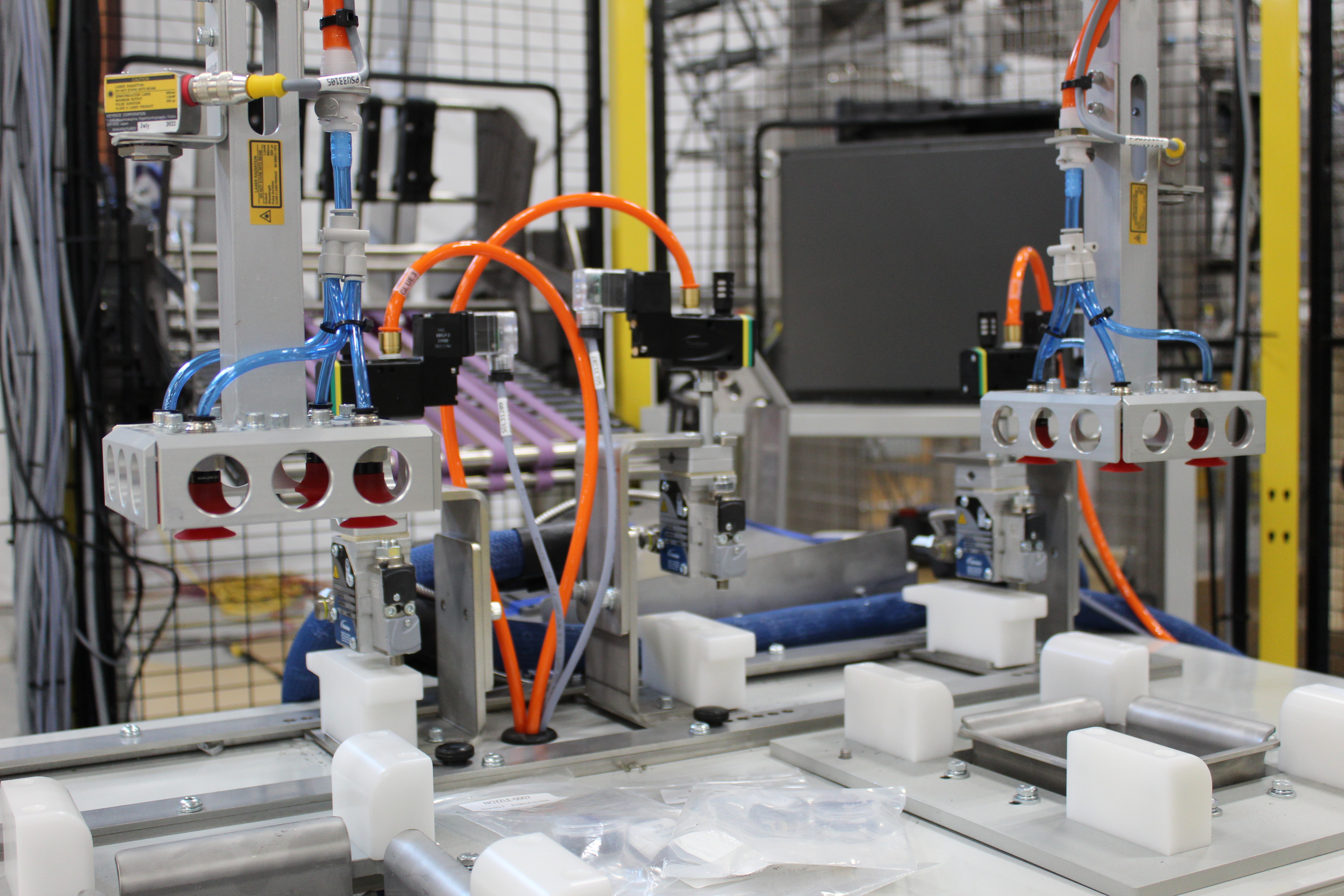
- End-of-arm tooling
With these technologies, systems can inspect products for defects, make real-time adjustments during handling, and work alongside operators in collaborative applications.
Misconception #4: A Cobot Can Do the Job
Cobots are a popular topic in the automation industry and have their place, but they often get misapplied in applications where an industrial robot would actually be a much more effective choice.
At QComp, we focus on the application first. Factors such as throughput, payload, safety requirements, and operator interaction determine whether a cobot, industrial robot, or another automation solution is the right fit.
RELATED:
Think You Need a Cobot? Know Their Limitations & Safety Risks
What Are Common Manufacturing Industry Automation Applications?
Applications that may have been considered impractical a decade ago are now being successfully automated.
That's why I encourage manufacturers to revisit automation opportunities, even if they've been told in the past that a process couldn't be automated. The capabilities available today may lead to a very different answer.
QComp has helped the following industries perform complex tasks to address labor shortages while improving throughput and quality.
- Identify and locate products using machine vision
- Inspect products for quality defects
- Pick and place soft nonwoven bags and flexible packaging
- Maintain high production rates without repetitive manual labor
- Handle wet wipes, lawn and leaf bags, hygiene products, and other flexible materials
- Pick, place, stack, and palletize flexible products and packaged goods
- Reduce repetitive material handling and ergonomic strain for employees
- Improve throughput and consistency across converting, packaging, and end-of-line processes
- Safely move large, fragile glass panels
- Detect and find glass in racks with angle and location variances with a combination of vision process and sensors
- Reduce employee exposure to hazardous handling tasks
- Inspect products for defects during processing
- Improve both product quality and workplace safety
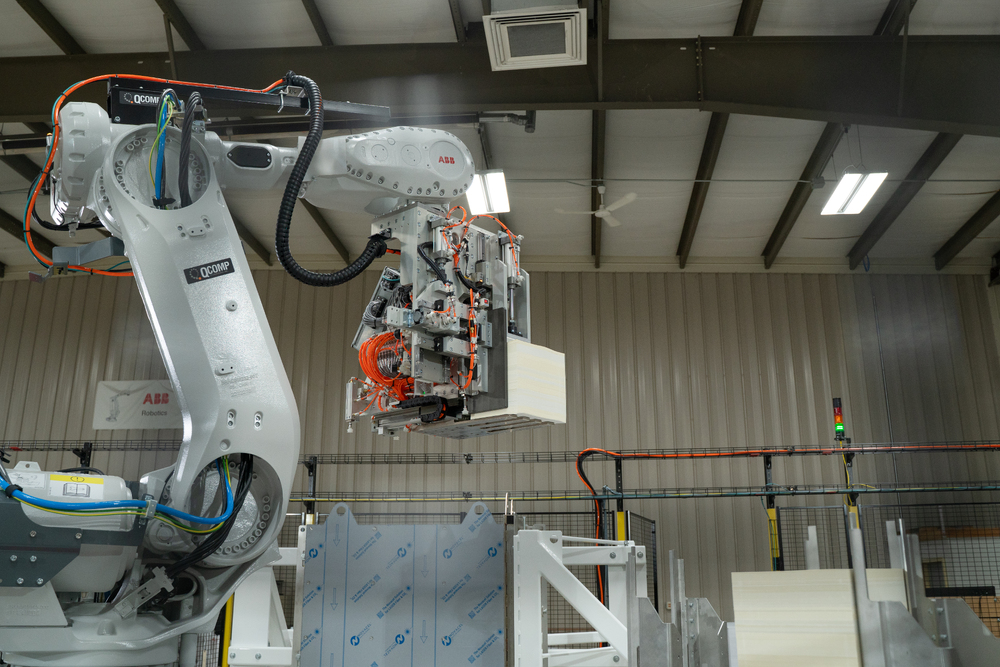
Real-World Example: Automating Looseleaf Paper Stacking
Challenge:
For years, operators manually stacked looseleaf paper ream by ream, carefully aligning each layer to maintain stack quality.
Solution:
QComp developed a robotic solution that automates the entire process, picking slugs of six reams at ~10 reams per minute and building tightly aligned 48-inch freestanding stacks onto finished pallets ready for the forklift.
Results:
- Reduced 3–4 manual operators to one forklift driver
- Eliminated repetitive, tedious motion
- Improved stack consistency and precision
- Freed skilled labor for higher-value work
Customer Response:
“You are doing what we thought was impossible."
VIDEO: See the Paper-Stacking Robot in Action!
Actual Automation Use Cases
One automation system we implemented involved operators placing bags of ingredients into a cup, 60 to 70 times per minute. The operators had to rotate with others on the line every 15 minutes because their hands kept cramping up. A system was installed to perform this function, doing it all day long, not only increasing the line throughput but also solving one of their hardest roles to fill.
Another food manufacturer had high turnover because the work environment was challenging—cold temperatures, physically demanding tasks, and highly repetitive work. The robots we designed didn’t mind the cold or working the same process hour after hour. In other words…
Robots don’t get bored and they thrive on repetition.
Can Automation Improve Safety and Ergonomics?
Recruiters and HR professionals tend to focus on compensation, benefits, and culture. That might convince a prospect to walk through the door, but it may not keep them there over time.
Safety and ergonomics often play an equally important role in employee retention. At QComp, safety is foundational to every automation system we design. As an A3 Certified Robot Integrator, we adhere to rigorous industry standards for robotic system safety, risk assessment, and operator protection.
When hazardous material handling tasks are automated, employees can focus on work that requires judgment, creativity, experience, problem-solving, and technical expertise. I've seen companies redeploy employees from manual material handling roles into quality, maintenance, programming, production support, and oversight of automated systems. These employees typically feel greater satisfaction in their roles because they require more than muscle.
Looking Ahead at the Future of Manufacturing Labor Challenges
According to a Manufacturing Institute and Deloitte study, manufacturers may need as many as 3.8 million new employees by 2033, yet nearly half of those positions—about 1.9 million jobs—could go unfilled if workforce shortages continue.2
We can help you face these uncertainties with confidence. To explore automation options, reach out to QComp. Our team will provide a site visit, walk the facility, and do a cursory audit of your operations to identify potential automation solutions that will make the biggest impact.
Sources:
1 National Association of Manufacturers. Manufacturing Job Openings Rise (May 2026).
2 Manufacturing Institute. Taking charge: Manufacturers support growth with active workforce strategies (2024).
Frequently Asked Questions About Easing Labor Shortages With Automation
Does automation replace workers in manufacturing?
In most manufacturing environments, automation is used to address labor shortages, improve safety, and increase productivity rather than eliminate jobs. Manufacturers often automate repetitive, physically demanding, or difficult-to-fill positions while redeploying employees to higher-value roles involving quality, maintenance, programming, troubleshooting, and system oversight.
How can automation help address manufacturing labor shortages?
Automation helps manufacturers maintain production when positions remain unfilled for extended periods. Robotic systems can operate around the clock, support second and third shifts, reduce reliance on overtime, and perform repetitive tasks that are often difficult to staff consistently.
What types of manufacturing processes can be automated?
Modern automation can handle a wide range of applications, including material handling, palletizing, packaging, machine tending, product inspection, food processing, glass handling, and vision-guided picking. Advances in robotics, machine vision, sensing technologies, and end-of-arm tooling continue to expand the types of processes that can be automated.
Is automation only practical for large manufacturers?
No. Manufacturers of all sizes are implementing automation to improve efficiency, address workforce challenges, and enhance product quality. The right solution depends on production requirements, labor availability, safety concerns, and business objectives rather than company size alone.
What is the typical ROI for a manufacturing automation project?
While every application is different, many automation projects achieve a return on investment within two to three years. ROI is typically driven by a combination of labor savings, increased throughput, improved product quality, reduced turnover, lower ergonomic risk, and greater production consistency.